


Micronutrients: essential for plants, but required in small quantities. Their deficiency compromises the quality and quantity of yields.
Micronutrients are so called because the plants need them in “small” quantities, despite their essential role. They are catalysts for many biochemical reactions and are essential for the formation of certain enzymes. Their possible deficiency can cause nutritional diseases affecting crops quality and yields.
Iron is an element with limited mobility in plants. For this reason, it must be supplied consistently throughout the entire agricultural cycle and especially during periods of increased vegetative growth and with low temperatures.
Iron is essential for crops mineral nutrition, being an integral component of the enzymes involved in fundamental biological processes (photosynthesis, respiration and DNA synthesis). It also plays a fundamental role as cofactor of the key enzymes involved in oxide reduction processes.
The importance of iron comes mainly from the fact that such element can exist in two different redox states: reduced (Fe2+) or oxidized (Fe3+). This characteristic allows it to be part of numerous electron-transfer reactions.
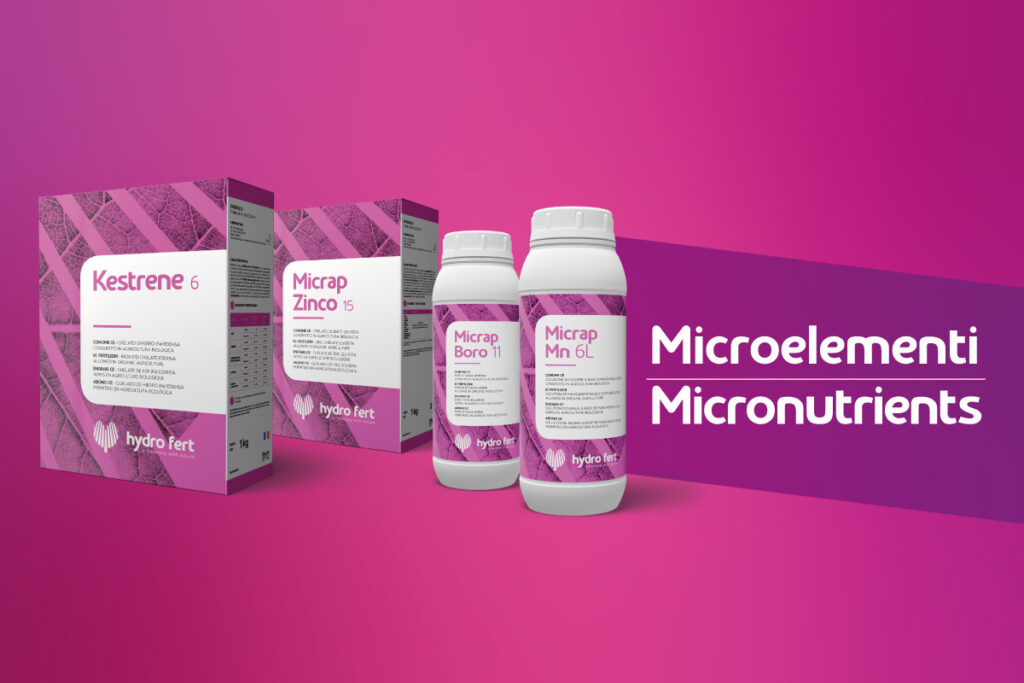
An iron deficiency causes leaf chlorosis. To solve such problem, Hydro Fert offers Kestrene 6, an iron chelate 6% EDDHSA fertilizer, studied to obtain a quick recovery of the photosynthetic activity and a lush green color.
Boron is fundamental during the flowering phase, affecting pollen vitality and, therefore, successful pollination and fruit setting.
Symptoms of a boron deficiency include marginal leaf necrosis and the presence of twigs with few leaves. To solve such problems, we suggest Micrap Boro 11, a formulation based on 11% boron ethanolamine stimulating the lengthening of pollen tube and favoring homogeneous and abundant fruit setting and production.
Manganese is an intermediate-mobility element able to activates enzymes, such as dehydrogenase and decarboxylase. It is essential for photosynthesis, cellular respiration and nitrates absorption.
Its deficiency can causes pale green coloration, with interveinal chlorosis on young leaves. To prevent such consequences, we suggest Micrap Mn 6L, a product containing manganese chelate 6% EDTA, which improves the organoleptic properties of fruits. It also plays a fundamental role in amino acid and peptide synthesis and in many enzymatic reactions, thus resulting an important element for plant metabolism.
Zinc is also a low mobile element and it is essential for the formation of tryptophan, a precursor of auxines synthesis.
A zinc deficiency is shown by signs such as: interveinal chlorosis, small and asymmetrical leaves and shortened internodes (due to auxin deficiency). Another characteristic symptom is the presence of spotted chlorosis.
To improve the quality and quantity of yields, we recommend Micrap Zinco 15, which contains zinc chelate 15% EDTA. Such element increases the production of tryptophan, a precursor of the synthesis of indole acetic acid, a growth regulator.
Source: Hydro Fert.