What are betaines?
Betaines are neutral organic compounds, namely molecules carrying both a positive and a negative electrical charge, resulting in a net charge of zero.
The best-known betaine in agriculture is glycine betaine, a molecule produced through the metabolism of glycine (an amino acid), to which three methyl groups (–CH₃) are added, hence the name trimethylglycine (TMG).
Functions of betaines
Betaines are classed as osmolytes. Their fundamental role is to help plant cells maintain their water balance and function properly, even under unfavourable environmental conditions. More specifically, when a plant suffers drought, salinity or heat stress, the concentration of salts and solutes outside the cell rises. As a side effect, water leaves the cell by osmosis, leading to a collapse. Betaines counteract this process in three ways:
1. they accumulate inside the cells, preventing water loss without altering the plants metabolism, thanks to their neutral charge and high solubility;
2. they are zwitterionic molecules, meaning they carry a positively charged quaternary ammonium group and a negatively charged carboxylate group, so their net charge is zero. Such structure gives them a strong affinity to water, the latter interacting with them more readily than with proteins surfaces. As a result, betaines tend to stay away from proteins, which end up surrounded by a more ordered and stable layer of water. This water “film” preserves the proteins’ native conformation and prevents denaturation, even under extreme environmental conditions such as drought, high salinity or extreme temperature;
3. betaines act on the photosystem, preventing it from shutting down under stress. Adverse weather conditions can lead to the detachment of some proteins essential for photosynthesis, but glycine betaine helps keep them anchored thanks to its ability to form stable bonds with water, thus allowing the photosystem to keep working properly.
Hydro Fert suggests many solutions containing betaines:
Betamin : a product with specific action based on amino acids of plant origin with seaweeds, that improves both root and vegetative development of plants, besides the absorption of nutrients and the photosynthetic efficiency. The content of betaines increases the osmotic potential of plant cells and reduces the abiotic stress, thus improving yields in terms of quality and quantity. Its repeated application increases the dry matter of fruits and plants. Betamin is highly effective in all the phenological phases of development, always guaranteeing the vegetal and reproductive balance.
Vigor L Rapido : a growth promoter 100% of plant origin, manufactured at low temperature and without chemical solvents, based on seaweeds (Sargassum, Laminaria). This product is made of micronutrients, vitamins, polysaccharides, natural phyto-hormones, as well as proteins and high-quality amino acids of plant origin from yeasts. Thanks to all its features, this product, used both in foliar applications and fertigation, is apt to achieve: higher number of flowers, better fruit setting, cell development, bigger high-quality yields, better organoleptic properties, longer shelf life, stronger plants resistance against stress, better vegetative regrowth, bigger roots and less sensitivity to micro-deficiencies.
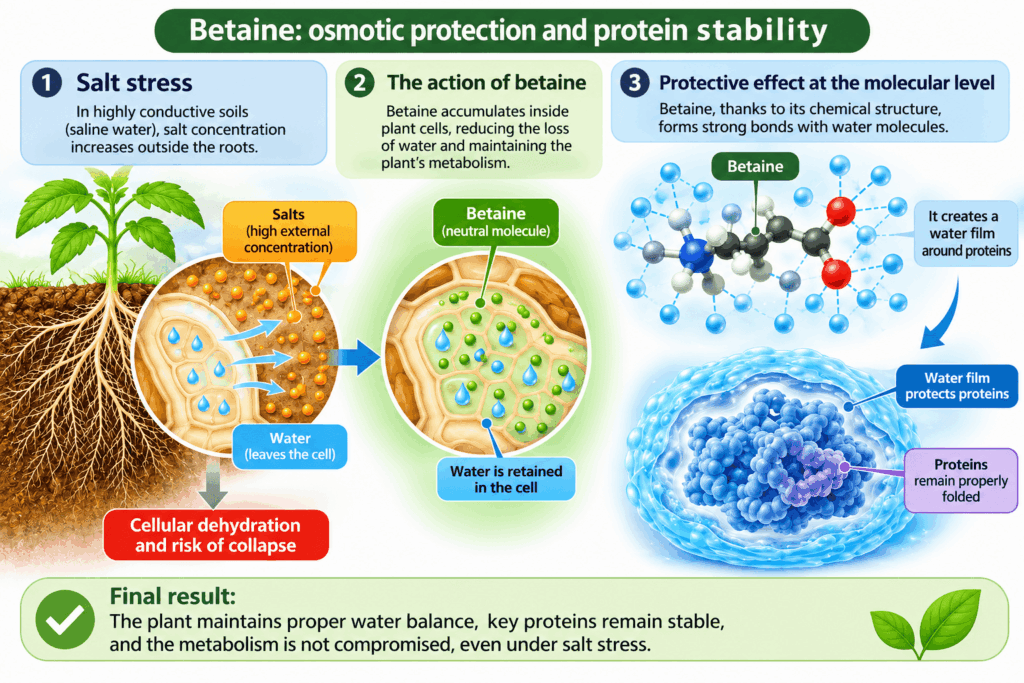
Fig. 1 Betaines functions.